Whether you’re an HVAC product designer, electronics R&D engineer, or medical equipment procurement manager, selecting the right fan is critical for your product’s performance, user experience, and reliability. Cross flow (tangential) fans stand out for uniform airflow, ultra-quiet operation, and slim profiles—but how do you know if they’re right for you? This guide simplifies selection, helping you avoid pitfalls with clear, practical advice.
1. Do You Need a Cross Flow Fan? 3 Core Needs to Check
Opt for a cross flow fan if your product faces these challenges:
- Need full-width uniform airflow: No hot/cold spots (ideal for air conditioners, refrigerated display cases).
- Pursue ultra-quiet operation: Critical for medical devices, bedroom appliances, or precision equipment.
- Limited installation space: Shallow/narrow cavities (e.g., slim home appliances, embedded systems) where traditional fans won’t fit.
Choose axial fans for high airflow at low cost, or centrifugal blowers for high pressure/long-distance ductwork instead.
2. Why Cross Flow Fans Outperform Others
Their unique design solves key pain points:
- Rectangular airflow: Covers entire widths, eliminating dead spots (unlike circular airflow from axial fans).
- Ultra-quiet: Lower blade speeds and stable vortex reduce turbulence—10-15dB quieter than axial fans (35dB max for standard models, 25dB for medical-grade).
- Slim profile: Flat, elongated shape fits shallow spaces (3-8cm depth), freeing up product design flexibility.
3. Cross Flow vs. Axial vs. Centrifugal: Quick Comparison
| Feature |
Cross Flow Fan |
Axial Fan |
Centrifugal Blower |
| Core Advantages |
Uniform airflow, quiet, slim |
High airflow, low cost |
High pressure, long-distance |
| Ideal Applications |
HVAC, display cases, medical devices |
Data centers, open-space cooling |
Ductwork, high-pressure systems |
| Potential Drawbacks |
Moderate pressure |
Noise, dead spots |
Bulky, complex installation |
4. Industry-Specific Applications
- HVAC: Split-system indoor units, slim heaters—uniform airflow and quiet operation enhance comfort.
- Air Curtains: Supermarket entrances, warehouse docks—wide air barrier cuts energy costs by 15-20%.
- Electronics: Server racks, 5G cabinets—slim design and vibration-free (G2.5 balance standard) protect precision components.
- Refrigeration: Supermarket display cases—temperature uniformity (≤1℃ difference) reduces food spoilage.
- Medical: Ultrasound machines, monitors—ultra-quiet (≤25dB) and CE/UL/RoHS certified for safety.
5. Key Selection Parameters
- Airflow (m³/h): Match to heat load (e.g., 100W = ≥150 m³/h; 300L display case = ≥200 m³/h). Avoid over-sizing—save energy and reduce noise.
- Dimensions: Impeller length (match product width) and installation depth (3-8cm typical). Customize for special sizes.
- Motor Type: AC (110V/220V/240V, cost-effective) or DC/EC (40% energy savings, 50,000+ hour lifespan). Choose dual ball bearings for precision equipment.
- Protection: IP55 rating for humid/dusty environments (factories, kitchens).
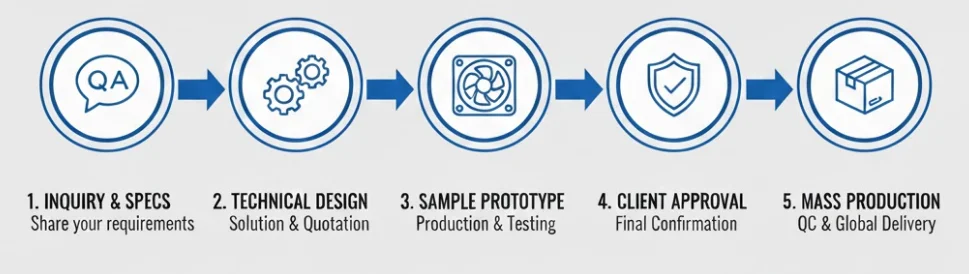
6. Customization & Order Process
Standard models don’t fit? We offer hassle-free customization:
- Share your needs: Application, airflow, dimensions, voltage, and special requirements.
- Get a tailored solution: 24-hour quote, drawings, and sample timeline.
- Fast delivery: 7-day samples, 15-day bulk production. Minimum order: 1000 units. Global shipping available.
7. FAQs
Q: How quiet are cross flow fans?
A: ≤35dB (standard) or ≤25dB (medical-grade)—quieter than library background noise.
Q: Are they export-ready?
A: Yes—CE, UL, and RoHS certified for global markets.
Q: What if performance is unsatisfactory?
A: Our engineers adjust based on your test data. 1-year motor warranty and lifetime technical support.
Contact our team for free 1-on-1 consultation:
Email: grace@ykfanmotor.com
Phone: +86-13710592354(wechat/WhatsApp)