1. Introduction
In household and industrial cooling solutions, the single-phase AC capacitor start motor (a typical single-phase asynchronous motor) is the core of the fan industry. Choosing the right AC capacitor motor, a key electric motor for cooling fans, directly determines a fan’s lifespan, noise level, energy efficiency, and operational stability. For fan motor manufacturers, mastering key knowledge of these motors is essential to optimizing product design, boosting competitiveness, and meeting end-user needs.
2. How AC Capacitor Start Motors Work: An Engineering Perspective
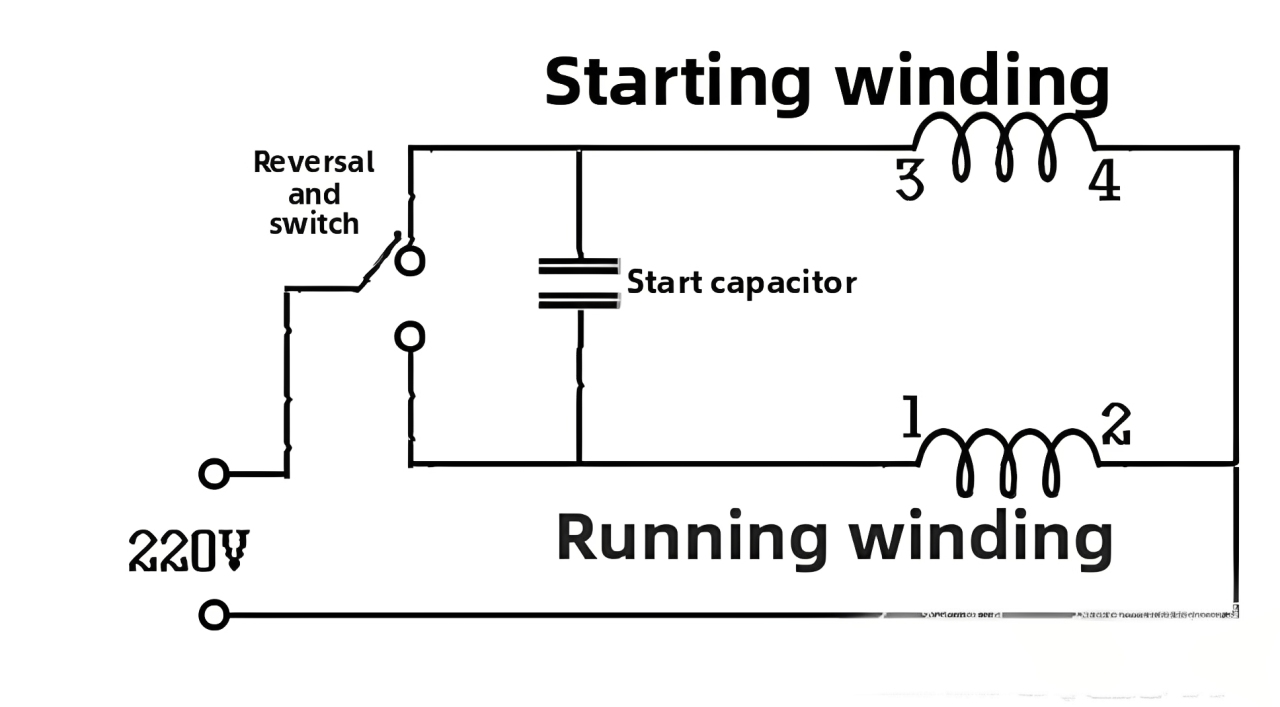
Unlike three-phase motors, single-phase asynchronous motors can’t independently generate the rotating magnetic field needed for startup. The capacitor in an AC capacitor motor, a vital type of single-phase asynchronous motor, is the "hidden hero" here, playing a pivotal role in the startup process.
2.1 Core Principle: Phase Shift, Torque & Energy Efficiency
AC capacitor start motors have two windings: main (running) and auxiliary (starting). The capacitor, connected in series with the auxiliary winding, creates a 90° electrical phase shift between the two windings’ currents, generating a rotating magnetic field to start the rotor. This field provides necessary starting torque; once at rated speed, the capacitor (in permanent-split designs) optimizes power factor, reducing reactive power and heat, while improving energy conversion efficiency—outperforming traditional capacitor-less single-phase motors.
3. Why AC Capacitor Motors Are the Top Choice for Fan Manufacturers
For fan motor manufacturers, cost, performance, and versatility drive competitiveness. AC capacitor motor, as the mainstream electric motor for cooling fans, stands out as the top choice due to these key advantages:
3.1 Cost-Effectiveness for Mass Production
Compared to DC brushless motors (BLDC), AC capacitor motors feature mature technology, simple structures, and lower costs. Ideal for mass-producing mid-to-low-end fans (table, wall, exhaust) and industrial cooling fans, they balance cost control and reliability. Their standardized industrial fan motor parts also simplify production and maintenance for fan motor manufacturers.
3.2 Excellent Noise Control Performance
Noise is critical to user experience. High-quality AC capacitor motors use precision bushings/bearings and optimized stator-rotor air gaps to minimize electromagnetic and mechanical noise, suitable for homes, offices, and other quiet-demand environments.
3.3 Strong Versatility
These AC capacitor motors, a versatile single-phase asynchronous motor, adapt flexibly in power, speed, and size to fit table, wall, pedestal, exhaust, and industrial cooling fans. This versatility cuts R&D and production costs for fan motor manufacturers, making it a universal electric motor for cooling fans.
3.4 Reliable Performance & Easy Maintenance
With simple structures and few wear parts, AC capacitor motors offer high reliability—even in harsh conditions like high-temperature exhaust scenarios. They’re also easy to maintain, reducing after-sales costs for manufacturers and users.
4. Key Quality Indicators of AC Capacitor Motors: What Fan Manufacturers Should Focus On
When sourcing AC capacitor motors (including industrial fan motor parts) as the electric motor for cooling fans, fan manufacturers should prioritize these key quality indicators over price to ensure performance and reliability of their single-phase asynchronous motor products:
4.1 Stator Stack Thickness
Stator stack thickness directly impacts magnetic flux and power output. A proper thickness ensures sufficient flux for better torque and efficiency; too-thin stacks cause low power, excess heat, and shorter lifespans.
4.2 Wire Material: Copper vs. Copper-Clad Aluminum (CCA)
Winding material affects conductivity, heat resistance, and reliability. 100% copper wire offers excellent conductivity, low resistance, and good heat dissipation for long-term stability. Copper-clad aluminum (CCA) is cheaper but prone to overheating and insulation aging. For reliable, long-life fans, 100% copper is non-negotiable.
4.3 Temperature Rise
Temperature rise reflects heat dissipation and insulation quality. High-quality AC capacitor motors operate within a specified range (≤75K under rated load) to avoid insulation breakdown and motor burnout. Always check test reports to ensure compliance with IEC, UL, and other international standards.
4.4 Capacitor Quality
As a core component, capacitor quality impacts startup performance and lifespan. High-quality capacitors have stable capacitance, good heat resistance, and long life; poor-quality ones cause startup issues, noise, or burnout, disrupting fan operation.
5. Conclusion
Choosing the right AC capacitor motor (single-phase asynchronous motor) is critical for fan manufacturers to improve product quality and competitiveness. Understanding its working principle and key quality indicators directly impacts final product performance and reliability.
Selecting a reliable motor supplier is equally important. At [Your Company Name], we integrate R&D, production, and quality control to specialize in AC capacitor motors and industrial fan motor parts. All products pass strict performance and safety tests, meeting IEC, UL, and other international standards. We’re committed to providing fan manufacturers with high-quality, cost-effective electric motors for cooling fans and professional technical support to drive sustainable development.


